It started with a farmer who did not exist.
Small farms. Monthly subscriptions. A crop plan for every field. A launch in Costa Rica. And one detail I added on purpose: the owner had never once thought about affiliates.
I wanted to see what our interviewer would do with that.
Round one: a stack of questions
Our interviewer is an AI agent. It does not install anything and it does not guess. It asks one question at a time, in plain words, and then hands the answers to a plain, boring program that decides which pieces to propose. Same answers, same stack, every time. The model cannot invent a piece that does not exist.
I gave it the farm. It asked what the service helps a farm do. Then whether several people share an account. Then the question that matters most for anyone who charges money: who should own the customer accounts?
Two honest options. On your WordPress site, where customers sign up, reset passwords and use a second factor, and one button opens the app already signed in. Or inside the app itself, a simple login that is fine for a prototype and not for paying customers. It recommended the first one. I took it.
Round two: the question I was waiting for
Here is the part I had changed that very afternoon. In the old version the agent asked, flatly, whether I wanted affiliates paid a commission. A farmer who has never heard the word says no, and a sale that could have been tracked is never tracked.
So the question is no longer yes or no. This is what it asked the farm:
“When someone buys from you, would you like to see where that sale came from, for example an agronomist, a co-op, or a reseller who sent the farmer to your site? And do you run your own campaigns, a newsletter, a field day, a flyer with a link, whose results you would want to measure? If any of that sounds useful, we’ll add an affiliate tracking system for you.”
I said agronomists and co-ops send me farmers all the time.
Round three: the first run fell on its face
I will tell you what happened the first time I tried the whole flow, because it is the reason the second version is better. I gave the agent a store with subscriptions and affiliates and no other need. It stopped. It had decided that nothing on the list needed a pack, so it sent an empty field, and our service rejected the call. No proposal, nothing installed, a polite apology.
Nothing was wrong with the service. The agent simply did not know that “nothing maps to a pack” is a valid answer. One sentence in its instructions fixed it: if nothing maps to a pack, send an empty list.
The proposal
This is what came back, from the real service, exactly as it was returned:
- Two packs: a workspace for the business, and the one that sends sign-in to WordPress and accepts customers WordPress has confirmed.
- Four things we do not build, we connect: an e-commerce plugin for the store and the subscriptions, an affiliate plugin for the partner program, a sign-in plugin for login and recovery, and a small WordPress plugin of ours that opens the app for a signed-in, email-confirmed customer.
- Account mode: WordPress, decided by the person, not assumed.
- The crop plan itself: no pack exists for it yet, so the agent wrote a short brief and told me to take it to our pack-building agent, where it would not have to be repeated.
It also refused to say anything was installed. Nothing was. The agent proposes; a person confirms; a separate step does the work.
This is how you build a ‘Brick House’
“The system’s stacked, and that’s a fact.”
Each brick is a small, boring, checkable thing: a pack with its own tables and security rules, a store you buy instead of write, a sign-in that someone else already perfected, a rule table that gives the same answer twice. Stack them in the order the customer’s answers dictate and you get a house that stands. The interview is how you find out which bricks.
If you would rather not lay the bricks yourself, that is what RapScalYon Commercial is for: we create the whole business, the website and the back office, on this same foundation, starting from this same interview.
What this was, and what it was not
This was a test with an invented farmer, run against a test copy of the interviewer, with the earlier answers repeated in each message because the test harness does not keep a conversation. The pack for crop plans does not exist yet. The affiliate plugin is part of the stack on paper; installing it on a client’s WordPress site is a step we are still building. I would rather tell you that than let a good story do the talking.
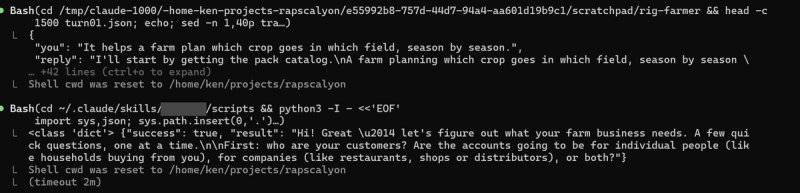
A word on how this was run, because it is half the point. The interview was not a person clicking through a form. A Claude Code session drove it from a script: it sent the invented farmer’s answers one at a time, read each reply, and pulled the pack catalog the way a real customer’s session would. We use our own tools on our own work before we ask anyone else to, so if the interviewer stumbles, the first people to watch it stumble are us. Eating our own dogfood is slower than shipping and a lot cheaper than apologising.
The agent that asked the new question is now the live one. Next up is the crop-plan pack.